
No products in the cart.
Return To ShopThe Easiest Way To Apply A Screen Protector
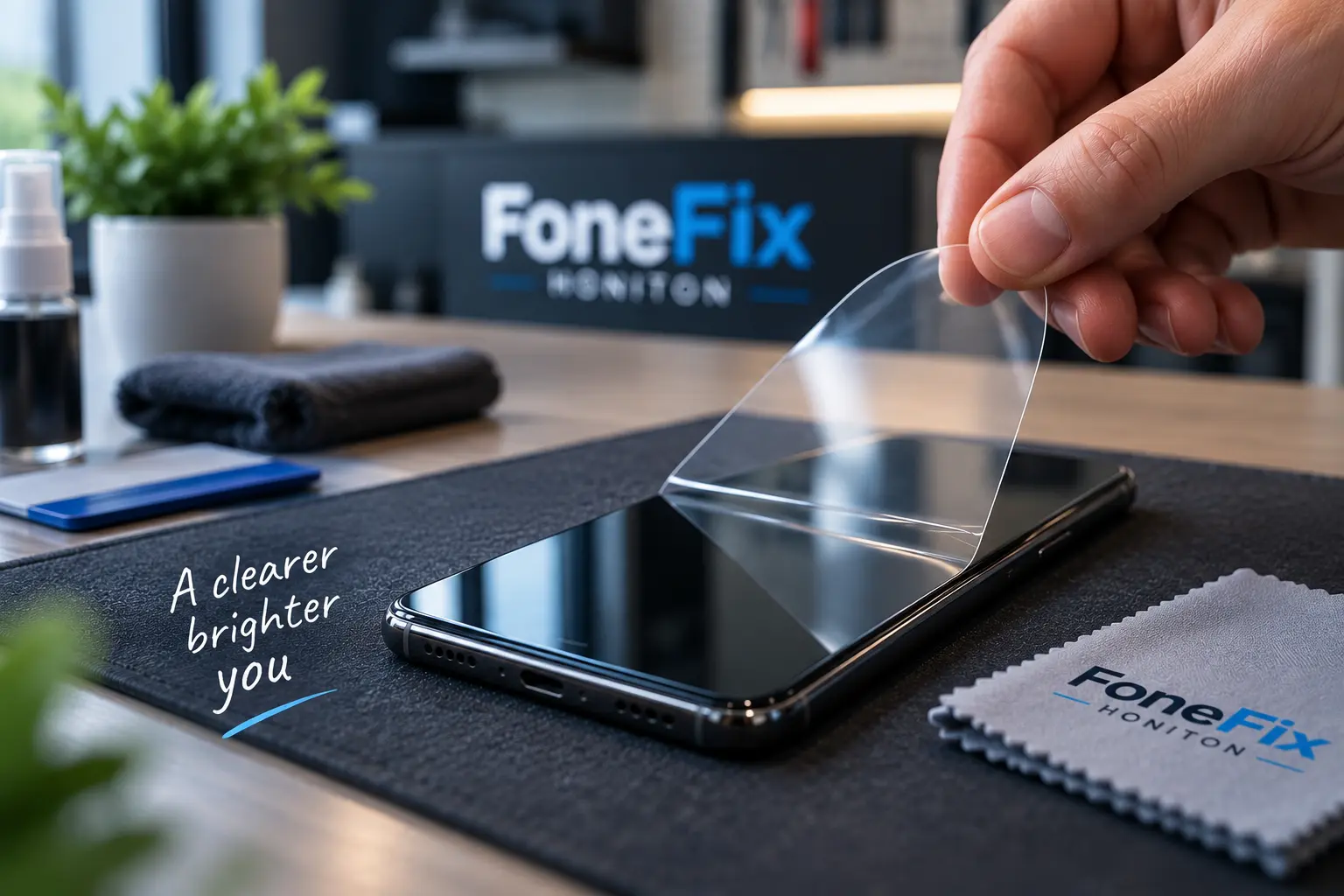
The Easiest Way To Apply A Screen Protector
Fitting a screen protector sounds simple enough. Clean the phone, line up the protector and stick it down.
In reality, anyone who has fitted a few will know how easily it can go wrong. One tiny piece of dust can leave a permanent bubble, the protector can end up slightly crooked, or you finally get everything perfectly aligned only to discover a speck underneath the middle of the screen.
We’ve fitted screen protectors at FoneFix for many years, and the preparation is usually more important than the actual application.
These days we use professionally fitted hydrogel screen protectors in-store, but the same basic rules apply whether you’re fitting a traditional tempered-glass protector yourself or having a hydrogel protector fitted.
What is the easiest way to apply a screen protector?
If you’re fitting a screen protector yourself, don’t rush straight into peeling off the backing.
First, find somewhere reasonably clean and free from dust. Wash and dry your hands, remove the phone case and clean the display thoroughly.
Use a suitable screen-cleaning cloth to remove fingerprints and grease, then inspect the display carefully for dust. A bright light shining across the screen can make tiny particles much easier to spot.
The important thing is to have the screen completely clean before exposing the adhesive side of the protector.
Once the backing is removed, avoid touching the adhesive. Hold the protector by its edges and line it up using obvious reference points such as the edges of the display, speaker or camera cut-outs.
With tempered glass, lowering one end into position first can make alignment easier. Once you’re happy that it’s straight, allow the protector to make contact with the display rather than repeatedly lifting and repositioning it.
Small air bubbles can often be pushed towards the edge using a soft cloth. A bubble caused by a piece of dust underneath the protector is different — pressing harder usually won’t make it disappear.
Why do I keep getting bubbles under my screen protector?
There are two common causes: air and dust.
An ordinary air bubble can usually be worked towards the edge of the protector.
A tiny piece of dust trapped underneath creates a raised point that prevents the adhesive sitting flat against the screen. This often leaves a small circular bubble that simply refuses to move.
This is why cleaning the display properly matters so much.
If you’re fitting tempered glass and notice a dust particle before the protector has fully bonded, it may be possible to carefully lift the nearest edge and remove the particle with a dust-removal sticker.
What you don’t want to do is repeatedly remove the entire protector, touch the adhesive or wipe underneath it with your fingers. That’s normally when one piece of dust turns into several.
Getting the screen protector straight
Alignment is the other part people struggle with.
Before removing the backing, place the protector over the phone and look at exactly where it needs to sit. Pay attention to the gap around each edge and any speaker, camera or sensor openings.
Some protectors come with alignment frames, which make this considerably easier.
Cases are worth considering too. A protector that sits extremely close to the edge of the phone can sometimes be pushed upwards by a tight-fitting case.
That’s particularly relevant on phones with curved or unusually shaped displays, where a rigid glass protector isn’t always the easiest material to fit neatly.
Tempered glass or hydrogel screen protector?
This is where screen protection has changed considerably.
For years, tempered glass was the obvious choice for most smartphones. It’s still a perfectly good option and, in some circumstances, we’d actually consider it the better one.
Hydrogel is different. Rather than being a rigid sheet of glass, it’s a very thin, flexible film that conforms closely to the shape of the display.
Neither material is automatically better at everything.
Advantages of tempered glass
A good tempered-glass protector has a very familiar feel because you’re touching glass rather than a flexible film.
It offers excellent resistance to everyday scratches and provides a rigid sacrificial layer over the phone’s display. If the phone suffers an impact, the protector itself may crack while the display underneath survives.
For a flat-screen phone where a correctly fitting protector is readily available, tempered glass remains a very good choice.
It’s also inexpensive and easy to replace once damaged.
Disadvantages of tempered glass
The biggest limitation is that glass is rigid.
That can make full coverage more difficult on phones with curved edges or unusual screen shapes. Poorly fitting glass can lift around the edges, collect dust underneath or interfere with some cases.
A cracked glass protector also needs replacing, even when the phone screen underneath is completely undamaged.
Some thicker or poorly designed glass protectors can also cause problems with under-display fingerprint readers.
What is a hydrogel screen protector?
Hydrogel protectors are thin, flexible films designed to sit closely against the phone’s display.
Their flexibility is one of the main reasons we use them at FoneFix.
Rather than keeping dozens of different pre-cut glass protectors in stock, our system allows us to produce a protector specifically for the device we’re fitting it to. This means we can cover a very wide range of phones and tablets, including models where a good-quality glass protector may be difficult to obtain.
Hydrogel also works particularly well on curved displays because the flexible material can follow the shape of the screen more closely than rigid glass.
What are the advantages of hydrogel?
One of the biggest advantages is how unobtrusive it is.
A properly fitted hydrogel protector is extremely thin and doesn’t add the raised glass edge that you get with a traditional tempered protector.
The material also has self-healing properties for very fine surface marks. That doesn’t mean a badly scratched protector magically repairs itself, but minor marks can become less noticeable over time.
Other advantages include:
- Excellent coverage, particularly on curved displays
- Very little additional thickness
- Good touchscreen sensitivity
- Good compatibility with many under-screen fingerprint readers
- No glass to crack or chip
- Protectors can be produced for a very wide range of devices
For customers who mainly want to keep their original display free from everyday scratches and marks, hydrogel is an excellent option.
What are the disadvantages of hydrogel?
This is important, because we sell hydrogel protectors but we don’t pretend they’re better than tempered glass in every respect.
Hydrogel is softer than glass.
If you particularly like the hard, slippery feel of the original phone display, you’ll probably notice that hydrogel feels slightly different under your finger. Some people notice this immediately; others barely notice it after a day or two.
It’s also primarily intended to protect against scratches, scuffs and everyday wear.
A good tempered-glass protector provides a more substantial rigid barrier against a hard direct impact. Hydrogel can absorb smaller knocks, but we wouldn’t sell it on the promise that it makes your phone screen unbreakable. Independent comparisons likewise tend to give tempered glass the advantage for hard-impact protection.
No screen protector can guarantee that a display won’t break if a phone lands badly.
That’s why we’d always recommend using a decent protective case alongside whichever type of screen protector you choose.
Hydrogel vs tempered glass: which should I choose?
It really depends on what matters most to you.
Tempered glass may suit you better if:
- You prefer the feel of real glass
- Your phone has a flat display
- Maximum scratch resistance is important
- You want a more rigid layer against impacts
- Suitable glass protectors are inexpensive and readily available for your phone
Hydrogel may suit you better if:
- Your phone has curved screen edges
- You want a very thin, discreet protector
- You use an under-display fingerprint reader
- You mainly want protection against everyday scratches and scuffs
- Glass protectors keep lifting around the edges
- You have a less common phone or tablet that’s difficult to find a protector for
There’s no need to pretend one is universally superior. They’re different products with different strengths.
Is it worth having a screen protector professionally fitted?
If you’re comfortable fitting your own tempered-glass protector, there’s nothing wrong with doing it yourself.
The trick is good preparation, careful alignment and keeping dust away from the adhesive.
At FoneFix, we’ve moved towards hydrogel protectors fitted in-store because they allow us to offer screen protection for a much wider range of phones and tablets without relying on a particular pre-cut glass protector being available.
The protector is cut for the specific device and fitted by us, so you don’t have to spend twenty minutes chasing dust around the kitchen table or discover you’ve applied it slightly crooked.
And if you’ve ever ruined the first protector and immediately had to open the second one, you’ll understand the attraction.
Hydrogel screen protectors fitted in Honiton
FoneFix is an independent phone and tablet repair shop based in Honiton, Devon, with more than 15 years of repair experience.
We supply and professionally fit hydrogel screen protectors in-store for a wide range of smartphones and tablets.
If you’re unsure whether hydrogel is right for your device, ask us. We’ll explain the difference between hydrogel and glass and, importantly, we’ll tell you where glass may actually be the better choice.
A screen protector can’t guarantee your display will survive every drop, but protecting the original screen from scratches and everyday damage is considerably cheaper than replacing it.
You can contact FoneFix Honiton to check whether we can produce a hydrogel protector for your device, or simply ask us next time you’re in the shop.